


Table of Contents
Thailand is one of the easiest countries in Asia to get internet as a tourist — prices are low, coverage in cities and tourist areas is strong, and the options for buying a SIM card are uniquely convenient. Whether you land in Bangkok, Phuket, or Chiang Mai, you'll be connected within minutes of clearing arrivals, and the cost is a fraction of what you'd pay in Europe or North America.
The main thing to understand before you go is the choice between three approaches: setting up an eSIM before you fly, buying a SIM at the airport kiosk, or picking up a cheaper plan from any of Thailand's 13,000+ 7-Eleven stores. All three are straightforward, but they differ in price, data volume, and how quickly you can get connected after landing.
This guide explains how to get internet in Thailand across all options — with current prices, coverage notes for the destinations tourists actually visit (Bangkok, Phuket, Chiang Mai, Koh Samui, Koh Tao, and others), and an honest explanation of what Thailand's famous “unlimited” data plans actually deliver. Here is what you need to know before you fly.
At a Glance
Here is what this guide covers:
- Your three main options: Airport SIM, 7-Eleven SIM, and eSIM — compared clearly
- Thailand's two main networks: AIS and TrueMove H (following the DTAC–True merger) — which is better for which destinations
- Airport SIM prices: What you get at Bangkok Suvarnabhumi, Phuket, and Chiang Mai airport kiosks
- The 7-Eleven advantage: Why buying from a convenience store is almost always cheaper than the airport
- eSIM for Thailand: Best providers, plan prices, and which networks they connect to
- “Unlimited” data plans: What the throttling threshold actually means in practice
- Island and rural coverage: What to expect on Koh Tao, Koh Phangan, Koh Lanta, and in northern Thailand


Your Options for Getting Internet in Thailand
| Option | Best for | Setup | Typical cost (30 days) | Main downside |
|---|---|---|---|---|
| Airport SIM kiosk | Immediate connection on arrival | 5–15 min. passport required | 299–499 THB (~$8–14) | More expensive than city options |
| 7-Eleven / city store SIM | Best value physical SIM | 10–20 min. passport helpful | 299–499 THB (~$8–14) | Need to get to a store first |
| eSIM (pre-installed) | Instant connection from landing | 2–5 min at home before flying | $8–25 depending on data | Data-only. eSIM phone required |
| Pocket WiFi rental | Groups sharing one connection | 10–20 min at airport desk | 150–300 THB/day (~$4–9) | Extra device to carry and charge |
The overall picture: Thailand is cheap for mobile data no matter which route you take. The eSIM wins on convenience for those with compatible phones; the 7-Eleven SIM wins on price-per-gigabyte for those willing to wait until they reach the city.
Thailand's Two Main Networks
Thailand's mobile market consolidated significantly in 2023 when True Corporation and DTAC merged to form a combined entity operating under the TrueMove H brand. The result is an effective duopoly:
AIS (Advanced Info Service)
AIS is Thailand's largest mobile operator by subscribers and consistently receives strong ratings for coverage quality — particularly in remote areas, the northern highlands, and smaller islands. AIS has the most comprehensive network infrastructure in the country and is the recommended choice for travellers whose itineraries go beyond major cities and beach resorts.
AIS's tourist-focused prepaid plans are straightforward, well-priced, and available at AIS shops, airport kiosks, 7-Eleven stores, and directly via eSIM through AIS's own app or international providers like Airalo and Klook.
Best for: Any itinerary that includes northern Thailand, remote islands, or rural areas. AIS is the safest single-network choice for a mixed Thailand trip.
TrueMove H (True + DTAC Merged)
TrueMove H is Thailand's second major operator, formed by the merger of True Corporation and DTAC. The combined entity has significantly strengthened its network, particularly in Bangkok and major tourist destinations. In urban and heavily visited areas, TrueMove H performs comparably to AIS — often with faster 5G speeds in Bangkok.
TrueMove H's tourist SIM plans are competitive and available through the same channels as AIS. For city-focused itineraries (Bangkok, Phuket, Pattaya, Samui), TrueMove H is an equally good choice.
Best for: Bangkok-heavy trips, urban Thailand, popular beach resorts.
The practical bottom line: For most Thailand tourist itineraries, both networks work well. If you're heading off the beaten path — northern hill tribe areas, remote islands, the Isan region — AIS has the network depth advantage.
Buying a SIM Card in Thailand
At the Airport (Convenient, Slightly Pricier)
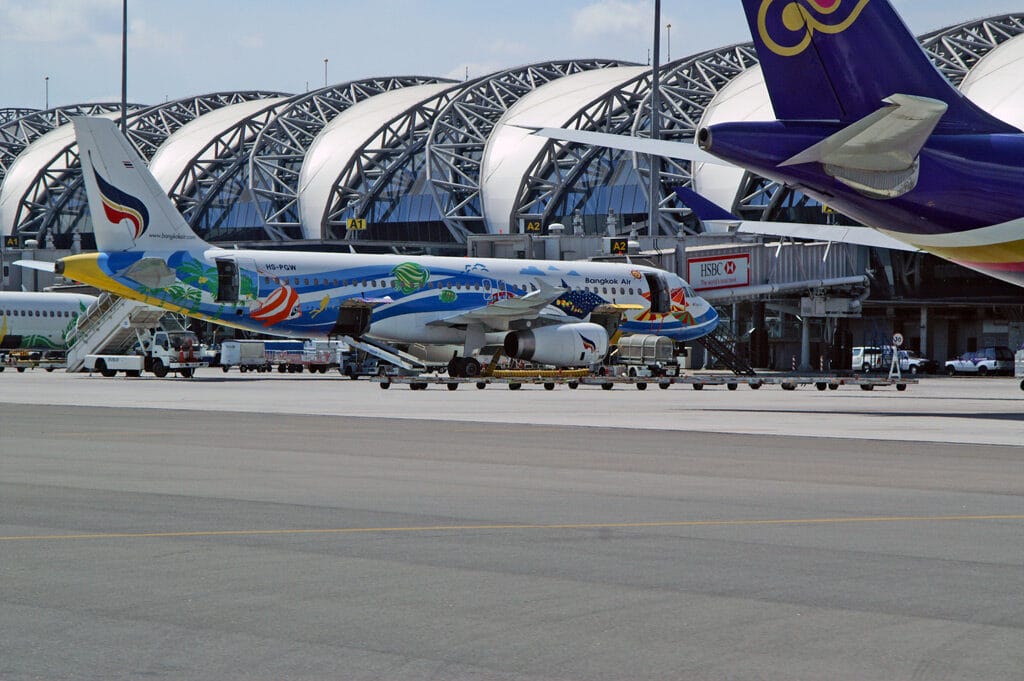
All of Thailand's major airports have operator kiosks in the arrivals hall. At Bangkok Suvarnabhumi (BKK) and Don Mueang (DMK), you'll find both AIS and TrueMove H kiosks immediately past customs. Phuket International (HKT) and Chiang Mai (CNX) also have operator kiosks.
What to expect at the airport:
- You'll need your passport for registration (required under Thai telecommunications law)
- Kiosk staff will insert the SIM, configure the plan, and test connectivity — this takes 10–15 minutes per customer, longer in queues
- Plans are clearly priced and staff are experienced with international tourists
- Prices are slightly higher than equivalent plans at 7-Eleven or city stores, but the convenience is real
Typical airport tourist SIM pricing (2026):
| Operator | Plan | Data | Duration | Price |
|---|---|---|---|---|
| AIS | Tourist SIM | 30 GB | 30 days | 299 THB (~$8.50) |
| AIS | Tourist SIM Plus | Unlimited* | 30 days | 399–499 THB (~$11–14) |
| TrueMove H | Tourist SIM | 30 GB | 30 days | 299 THB (~$8.50) |
| TrueMove H | Tourist SIM Max | Unlimited* | 30 days | 399–499 THB (~$11–14) |
*See the “Unlimited Data” section below for what the asterisk means in practice.
At 7-Eleven — Thailand's Best-Kept SIM Secret
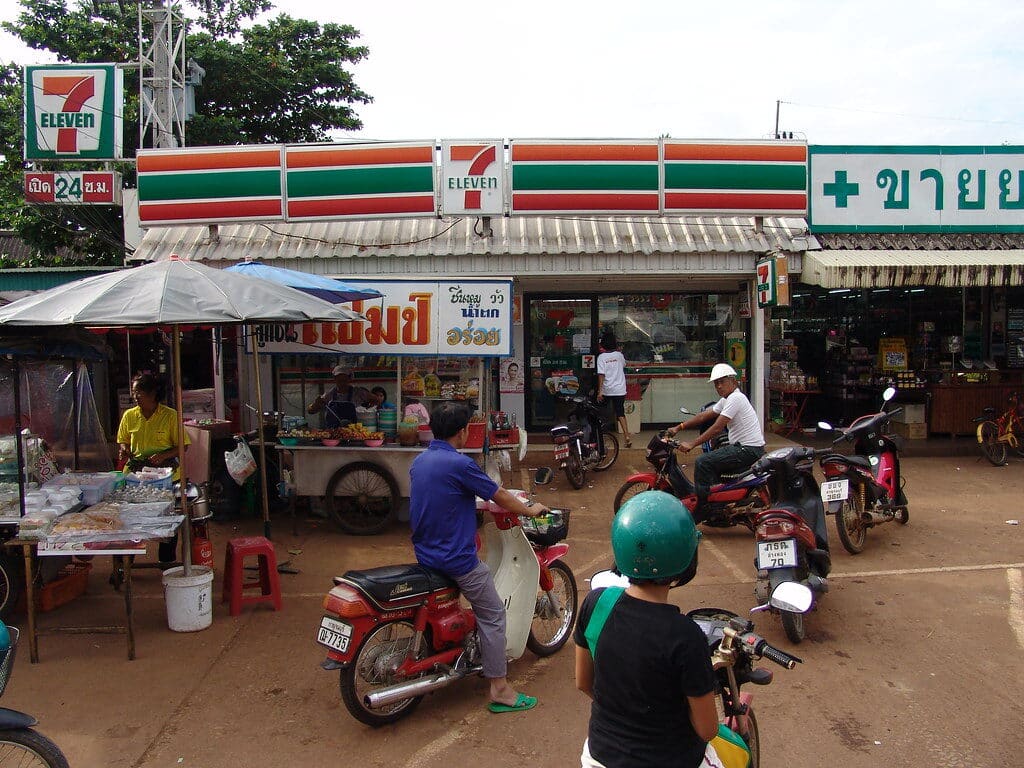
Thailand has more 7-Eleven stores per capita than almost any country in the world — over 13,000 across the country. Almost every 7-Eleven sells prepaid top-up packages for AIS and TrueMove H. Many also sell SIM cards directly.
Buying at 7-Eleven has two advantages: it's often cheaper than the airport, and it's available everywhere — in every Bangkok neighbourhood, in Chiang Mai's old city, in beach towns across the south, and even on many islands. If you run out of data mid-trip, a top-up is minutes away.
How to buy a SIM at 7-Eleven:
- Ask the cashier for the SIM card display (or look for the wall-mounted package rack)
- Choose AIS or TrueMove H; select your plan package
- Show your passport at the register (required, though enforcement is variable)
- The cashier processes the SIM; insert it yourself or ask for help
- Dial the activation code printed on the packaging (instructions are on the pack)
Some packages come as a SIM card with a separate data plan voucher — buy both together. If you're unsure, AIS and TrueMove H both have assistance lines you can call after inserting the SIM.
Best tourist SIM plans available at 7-Eleven / city stores (2026):
| Operator | Plan | Data | Duration | Price |
|---|---|---|---|---|
| AIS | Happy Tourist | 100 GB | 30 days | 299 THB (~$8.50) |
| AIS | Happy Tourist Max | Unlimited* (30GB full speed) | 30 days | 499 THB (~$14) |
| TrueMove H | Tourist SIM | 30 GB | 30 days | 299 THB (~$8.50) |
| TrueMove H | Unlimited* (50GB full speed) | Unlimited* | 30 days | 399 THB (~$11) |
The headline number: 100 GB for 299 THB (~$8.50) is one of the best data deals available anywhere in Asia. For a 30-day trip with normal usage, this covers everything.
eSIM for Thailand: Set Up Before You Land
For travellers with eSIM-compatible phones, buying and installing an eSIM before you fly means being connected the moment you land — no queue at the airport kiosk, no passport presentation required.
Check eSIM Compatibility
Settings > Cellular (iPhone) or Settings > Network & Internet (Android). Look for “Add eSIM” or “Add Mobile Plan.” Compatible devices: iPhone XS and newer, Pixel 3 and newer, Samsung Galaxy S20 and newer, plus many other recent Android models.
Best eSIM Plans for Thailand (2026)
| Provider | Plan | Price | Data | Network | Notes |
|---|---|---|---|---|---|
| Roafly | 10 GB / 30 days | $10.00 | 10 GB | AIS / TrueMove H | Good entry-level. hotspot supported |
| Roafly | 20 GB / 30 days | $16.00 | 20 GB | AIS / TrueMove H | Best Roafly value for standard trips |
| Airalo | Thailand 10 GB / 30 days | ~$13 | 10 GB | AIS | Most popular Airalo Thailand plan |
| Airalo | Thailand 20 GB / 30 days | ~$20 | 20 GB | AIS | Good for heavier users |
| Holafly | Unlimited / 7 days | ~$24 | Unlimited* | AIS / TrueMove H | Best for heavy users short trips |
| Holafly | Unlimited / 30 days | ~$69 | Unlimited* | AIS / TrueMove H | Long-stay unlimited option |
| Klook | AIS 5G Unlimited / 15 days | Varies | Unlimited* | AIS | Direct AIS plan via Klook. hotspot included |
eSIM vs. local SIM in Thailand — the price comparison:
An Airalo 10GB plan at 13 is slightly more expensive than the AIS100 GB SIM card at 299 THB (8.50). For shorter trips where you don't need 100GB, the convenience premium of an eSIM is small. For heavy users or longer stays, the 7-Eleven SIM is dramatically better value per gigabyte.
The multi-destination angle: If your trip combines Thailand with other Southeast Asian countries — Vietnam, Cambodia, Indonesia, Malaysia — Holafly and Airalo both offer Asia multi-country eSIM plans that cover all these countries under one plan. This is significantly more convenient than buying a new SIM at each border.

Stay connected across Thailand with instant mobile data. Activate before you fly and use your phone as soon as you land.
“Unlimited” Data in Thailand: What It Actually Means
Almost every Thai operator's “unlimited” tourist plan comes with a data speed threshold. This is standard practice in Thailand and worth understanding before you choose a plan.
How it works:
- You get a specified amount of data at full 4G/5G speed — typically 15–50GB depending on the plan
- Once you reach that threshold, your speed is throttled — usually to 1 Mbps
- Your data doesn't stop or cut off; it continues at the reduced speed for the rest of your plan period
What 1 Mbps actually means in practice:
- Google Maps navigation: ✅ Works fine (maps load at 1 Mbps without issue)
- WhatsApp, Line, messaging: ✅ Works fine
- Web browsing: ✅ Works fine for most sites
- Social media (photos): ✅ Works fine, slightly slower uploads
- Video calls (WhatsApp, FaceTime): ⚠️ Acceptable quality at 1 Mbps; HD calls may buffer
- YouTube / streaming at HD: ❌ Will buffer frequently; SD video is possible
The practical takeaway: For navigation, messaging, and standard tourist use, a throttled Thai “unlimited” plan works well even after the full-speed threshold. For travellers who stream video regularly or have heavy data needs, either buy a higher-tier plan with a larger full-speed allowance or monitor your usage carefully. The 100GB/299 THB plan from AIS gives most tourists more than enough full-speed data without ever hitting the threshold.
Free WiFi in Thailand
Thailand has strong café culture, particularly in Bangkok and Chiang Mai, and free WiFi is available at a high density of locations.
Where WiFi works well:
- Hotels and guesthouses — essentially universal, including budget accommodation
- Cafés and co-working spaces in Bangkok (Silom, Sukhumvit, Thonglor, Nimman in Chiang Mai) — some of the best digital nomad WiFi in Asia
- Bangkok's Suvarnabhumi Airport — fast and free
- Most resort restaurants on Phuket, Koh Samui, and Krabi
- Many 7-Eleven stores have free AIS WiFi (connect without a password)
Where WiFi is less reliable:
- Smaller island accommodation — particularly during high season when bandwidth is shared across many guests
- Boats and ferries between islands — no WiFi; download what you need beforehand
- National parks and jungle trekking areas
- Rural guesthouses in northern Thailand
The Bangkok co-working note: Bangkok has one of the highest concentrations of co-working spaces and café WiFi in Southeast Asia. For digital nomads or travellers who need reliable bandwidth for work, Bangkok is excellent. The WiFi infrastructure in good Bangkok cafés often outperforms hotel WiFi.
Pocket WiFi in Thailand: When It Makes Sense
Pocket WiFi rental is a practical option in Thailand — more so than in most European countries — for a specific use case: groups or families sharing a connection.
How to rent:
- Airport desks at Suvarnabhumi and Don Mueang arrivals (look for AIS, TrueMove H, or third-party rental desks)
- Pre-order online for airport pickup
- Hotel concierge services
Typical cost: 150–300 THB per day ($4-9), depending on the data tier. A weekly rental runs 1,000-2,100 THB ($28-60)
When pocket WiFi makes sense:
- A family of 3–4 people with multiple devices — splitting a rental is cheaper than 4 individual SIMs
- Travellers who need to connect a laptop all day and don't want to use hotspot data from their phone
When it doesn't make sense:
- Solo travellers or couples — an eSIM or local SIM is cheaper and simpler
- Anyone who might forget to charge it overnight
Coverage in Thailand's Key Destinations
Bangkok
Excellent 4G/5G coverage from both AIS and TrueMove H throughout the city. BTS Skytrain, MRT underground, and major tourist areas (Sukhumvit, Silom, Khao San Road, Chatuchak, Siam) all have strong signal. Suvarnabhumi and Don Mueang airports have full coverage with operator kiosks.
Phuket
Strong coverage island-wide. Patong Beach, Kata, Karon, Phuket Town, and the main tourist areas all have reliable 4G/5G. The interior and west coast roads may have slightly weaker signal in some spots — both AIS and TrueMove H cover the island well.


Chiang Mai
Excellent coverage throughout the old city, Nimman Road, and surrounding areas. The road to Doi Inthanon National Park is generally well-covered; mountain summit and more remote trekking areas become patchier — AIS has better coverage in the northern highlands.
Koh Samui
Good coverage in Chaweng, Lamai, and main tourist areas. A cable and microwave link brings connectivity to the island — both operators have coverage. Interior roads and the north coast can be patchier.


Koh Tao and Koh Phangan
Coverage on both islands is available but variable. AIS is consistently the stronger operator on Koh Tao. During Full Moon Party weeks on Koh Phangan, network congestion can affect signal quality as thousands of additional users hit the same towers. Download maps and any essential information before arriving on these smaller islands.
Koh Lanta, Koh Lipe, and Remote Islands
AIS is the recommended network for any of the smaller southern islands. Some tiny or uninhabited islands near Koh Lipe (close to the Malaysian border) may have no coverage at all. The main village and resort areas of Koh Lanta and Koh Lipe have coverage; jungle trails and remote beaches do not.


Northern Highlands (Mae Hong Son, Golden Triangle, Chiang Rai Province)
AIS has the strongest coverage in Thailand's northern mountain regions. TrueMove H coverage exists in main towns but thins out in rural and border areas. For road trips through Mae Hong Son, Pai, or the Golden Triangle, AIS is the more reliable choice.


Frequently Asked Questions
Do I need to show my passport to buy a SIM in Thailand?
Officially yes — Thai telecommunications regulations require ID registration for prepaid SIM purchases. At airport kiosks, passport registration is consistently required. At 7-Eleven stores, the requirement is technically in place but enforcement is more variable — some stores ask, others don't. At operator stores, registration is standard. For eSIM purchases from international providers like Airalo, Holafly, or Roafly, no ID is required.
How much does a SIM card cost at Bangkok airport?
At Suvarnabhumi (BKK) and Don Mueang (DMK) arrivals, tourist SIM plans typically cost 299 THB (~$8.50) for a 30GB/30-day plan, or 399-499 THB ($11-14) for unlimited* plans. These prices are reasonable by international standards — the airport premium in Thailand is smaller than in most European countries. The main reason to choose a 7-Eleven SIM instead is that equivalent or better plans (100GB for 299 THB) are sometimes available in stores at the same or lower price.
Is AIS or TrueMove H better for tourists?
For most tourist itineraries, both are comparable. AIS has the edge in rural areas, smaller islands, and northern Thailand — if your trip includes any of these, AIS is the safer choice. For Bangkok-heavy or major resort trips, TrueMove H is equally good and sometimes faster in 5G areas. Many eSIM providers list AIS as their Thailand network partner, which is why AIS-backed plans are the most commonly recommended.
Can I use my Thailand SIM in other Asian countries?
Thai prepaid SIM cards include roaming in some Southeast Asian countries, but it's limited and can be expensive depending on the plan. For multi-country Asia trips combining Thailand with Vietnam, Cambodia, Indonesia, or Malaysia, a regional Asia eSIM plan is more practical than relying on a Thai SIM's roaming. Providers including Holafly and Airalo offer Asia multi-country plans starting from around $30–40 for 10GB across 8–12 countries.
What happens when I run out of data on a Thai tourist SIM?
On plans with a fixed data allowance (e.g., 30GB), your data stops when the limit is reached. To continue, buy a top-up voucher — available at any 7-Eleven, operator store, or through the operator's app. On “unlimited” throttled plans, your data doesn't stop — it continues at reduced speed (1 Mbps). Top-up is still possible to restore full-speed data if needed.
Is there good internet on the islands during high season?
Popular islands (Koh Samui, Koh Phangan, Phuket) maintain reliable mobile coverage year-round, including during high season. Smaller islands (Koh Tao, Koh Lanta) are generally well-covered in resort areas; WiFi quality at accommodation varies. During peak events like Koh Phangan's Full Moon Party, mobile network congestion is noticeable — the towers handle significantly more users than normal. AIS tends to hold up better under congestion conditions than TrueMove H on smaller islands. Download maps and anything you need before arriving on smaller islands.
Final Thoughts
Getting internet in Thailand is one of the easier logistics of a Thai trip. Prices are among the lowest in Asia, the airport kiosks are efficient, and the 7-Eleven network means a top-up or new SIM is accessible almost anywhere in the country.
For most travellers, the decision is simple: eSIM if your phone supports it and you want connectivity from the moment you land; airport SIM if you want staff to handle setup; 7-Eleven SIM if you want the best price and don't mind a short wait. All three deliver reliable connectivity for a standard tourist itinerary.
The one nuance worth planning for is island coverage. Download offline maps before leaving the mainland or a large island for smaller destinations — AIS gives the widest coverage net for island-hopping, and being prepared means connectivity gaps don't become navigation problems.
Stay connected across Thailand with instant mobile data. Activate before you fly and use your phone as soon as you land.
➡ How to avoid roaming charges in Vietnam
➡ Is an eSIM worth it in Indonesia?
➡ Best way to get mobile data in Japan
Add your first comment to this post